By Alexandru Goncear, owner of ElectON Enterprise. Washington electrical contractor license ELECTEL765MN.
If your Bellevue house was built or added onto between about 1965 and the mid 1970s, some of its 15 and 20 amp circuits may be aluminum. That covers a lot of the split-levels and ramblers in Eastgate and on the streets around Robinswood Park.
The U.S. Consumer Product Safety Commission recognizes three permanent repairs: replacing the aluminum with copper, or pigtailing every aluminum connection in the house with either COPALUM crimp connectors or AlumiConn connectors. CO/ALR outlets and twist-on wire nuts only buy time. In most houses the real decision is between AlumiConn pigtails throughout and new copper wire. Which one makes sense depends on how easy your attic and walls are to get into, whether a remodel is coming, and what your insurance carrier will accept.
Which Eastgate and Robinswood houses are likely to have it
The City of Bellevue’s January 2026 existing-conditions report on Eastgate counts about 3,300 housing units, roughly 70 percent of them single-family. Most were built in two waves, the mid-20th century and the 1980s and 1990s, and the common house types are split-levels and classic ramblers. Robinswood Park sits just north of Eastgate, and the houses around it also span several decades.
Before the mid 1960s, aluminum went mostly into big appliance circuits like ranges and dryers. When copper got scarce and expensive, builders started using it on ordinary 15 and 20 amp household circuits as well. The CPSC says homes built before 1965 are unlikely to have aluminum branch wiring, and that cable installed from 1965 to the mid 1970s may be aluminum whether it went into a new house, an addition, or a rewired circuit.
So a 1959 rambler with a family room added in 1970 can have copper in the original rooms and aluminum in the addition, while a house from the 1980s wave is almost always past the window. The year your house was built, and the years it was added onto, tell you more than the neighborhood name does. Both dates are on the King County Assessor’s property record, listed as year built and year renovated.
Why aluminum connections fail
The trouble with aluminum branch wiring is at the connections. Aluminum expands and contracts more than copper every time a circuit warms up and cools down, and over thousands of cycles it creeps out from under a screw terminal until the connection is loose. Aluminum also grows an oxide layer that resists current. A loose, oxidized connection runs hot, and the heat speeds up the same damage.
In a national survey done for the CPSC, homes built before 1972 and wired with aluminum were 55 times more likely than copper-wired homes to have at least one outlet connection reach “fire hazard conditions.” The survey only looked at outlets. Switches, light fixtures and junction box splices fail the same way.
The CPSC also warns that these connections often fail with no warning at all. When there are signs, they tend to be:
- A switch or outlet cover plate that feels warm
- Lights that flicker or dim for no clear reason
- An outlet, or a whole circuit, that stops working
- A smell of hot plastic near an outlet or switch
If you smell that right now, turn off the breaker for that circuit and call us. Our post on what to do about a burning smell from an outlet covers the first ten minutes, and our emergency electrical service answers around the clock for Bellevue and the rest of the Eastside.
How to tell whether your house has aluminum wiring
You can usually find out without opening anything. Start with the cable jacket. Aluminum branch wiring went in as plastic-sheathed cable that looks almost the same as copper cable from the outside, but the jacket is printed or embossed every few feet with “AL” or “ALUMINUM,” often next to a brand name such as Kaiser. In a split-level, exposed cable is easiest to find on the garage ceiling, in the unfinished utility room by the panel, and at the attic hatch. Hold a flashlight at a low angle and embossed letters get much easier to read.
If the jacket says “copper-clad” or “CU-clad” along with “AL,” the wire is copper-clad aluminum. That is a different product, and the CPSC repair guidance doesn’t apply to it.
Wire size is another clue. Aluminum branch circuits used one size larger than copper for the same breaker: 12 gauge aluminum on a 15 amp circuit and 10 gauge on a 20 amp circuit, where copper would be 14 and 12. Home inspectors often note this in their reports.
Heavy stranded aluminum feeding a range, a dryer, a subpanel or the service entrance is a separate case. It’s common, it’s still used in new homes, and the CPSC guidance specifically excludes it. The concern is the small solid wire on everyday circuits.
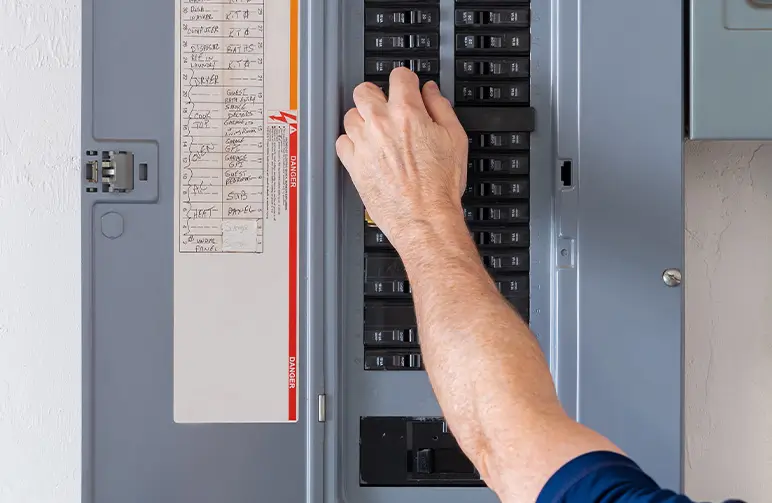
Don’t open the panel or pull outlets out of the wall to check. If you can’t see cable markings anywhere, have an electrician confirm what you have.
How the repair options compare
| Repair | How it works | CPSC position | What to know |
|---|---|---|---|
| Replace with copper | New copper circuits run to every outlet, switch and fixture. The aluminum is disconnected and abandoned in the walls | Permanent, and the best method | Most disruption and the highest cost. Also adds grounded outlets and new circuits |
| COPALUM pigtails | A short copper lead is crimped to each aluminum wire with a powered tool that cold-welds the joint | Permanent | Only installers trained by the manufacturer can do it, and few are available |
| AlumiConn pigtails | A short copper lead is joined to each aluminum wire inside a set-screw connector listed for both metals | Permanent. The CPSC’s next choice when COPALUM isn’t available | Depends on careful installation. The connectors are bulky, so some boxes need to be deepened |
| CO/ALR outlets and switches | Devices rated for direct connection to aluminum | Incomplete repair | Not available for light fixtures or hardwired appliances. Have failed in lab testing |
| Twist-on connectors | Pigtails made with wire nuts, including ones labeled for aluminum to copper | Emergency or temporary use only | Many overheated badly in CPSC testing |
Pigtailing has to cover every connection
The CPSC says a pigtail repair should include every aluminum connection in the house:
- Every receptacle and switch, dimmers included
- Every ceiling and wall light fixture on an aluminum circuit
- Hardwired smoke alarms on those circuits
- Hardwired appliances such as dishwashers, disposals and electric baseboard heaters
- Splices in junction boxes, including the ones in the attic and crawlspace
- The aluminum conductors where they land in the panel
A common shortcut is to pigtail the three outlets that were giving trouble and leave the other forty connections alone, and the owner walks away thinking the house is fixed. We see the same pattern with partial rewires from the 1980s.
A good pigtail job also deals with box fill. A lot of 1960s outlet boxes are shallow, and adding a copper lead and a connector for every wire can put more in the box than the code allows. Crammed boxes are where the next overheated connection comes from. Sometimes the fix is a box extension, sometimes a new box. If a quote doesn’t mention box fill, ask how they plan to handle it.
COPALUM
COPALUM has the longest track record of the three; the CPSC’s guidance cites more than a quarter century of field use. Each aluminum wire is joined to a short copper lead inside a metal sleeve, and a dedicated power tool squeezes it with upwards of 10,000 pounds of force, so the joint is effectively a cold weld.
Getting it done is harder. TE Connectivity, the manufacturer, only authorizes electricians it has trained on the tool, and the CPSC itself says the repair may not be available everywhere. If a contractor offers COPALUM, ask to see their authorization.
AlumiConn
AlumiConn is a small connector with a separate set-screw port for each wire, listed for joining aluminum and copper. The CPSC calls it the next best option when COPALUM isn’t available, and notes that it has a shorter field history.
The connector is only as good as the person installing it. Each set screw has to be tightened with a torque screwdriver set to the manufacturer’s spec, and the aluminum has to be clean and undamaged where it goes into the port. Done that way at every connection in the house, it gives you a permanent repair without running new wire through the walls.
Replacing the aluminum with copper
New copper takes the aluminum out of service for good. It also takes care of problems pigtailing can’t touch, such as two-prong outlets with no ground and kitchens wired for a toaster and a percolator, because the new circuits are grounded and can be laid out for how you use the house now.
Split-levels are often easier to rewire than people expect. The attic gives access to the upper floor, and the lower level or garage gives access from below. Ramblers with an attic and a crawlspace are similar. Some walls still have to be opened, and a full rewire is the biggest of these jobs. Our whole-house rewiring page explains how we work in zones so you can keep living in the house, and we broke down four recent rewire jobs and why their prices differed.
CO/ALR devices and twist-ons
CO/ALR switches and outlets do better on aluminum than standard devices, but they have still failed in CPSC lab tests that simulated normal use, and there is no CO/ALR version of a hardwired appliance or a ceiling light fixture. Twist-on pigtails, including connectors rated for aluminum to copper, overheated in large numbers in CPSC testing. The CPSC accepts either one only as a temporary fix for a single failed connection, with a full repair to follow as soon as possible.
How to choose for your house
- If you plan to remodel the kitchen or a bathroom in the next couple of years, pigtail the house now and replace the wiring in those rooms with copper while the walls are open.
- If your panel is a Federal Pacific Stab-Lok or a Zinsco, or the house is still on 100 amps, look at the panel too. Both brands went into Bellevue houses in the same years as aluminum wire, and both have a record of breakers that don’t trip when they should. The panel replacement may need to come first or happen at the same time.
- If the house also has a lot of two-prong outlets, a rewire solves both problems at once. Pigtailing doesn’t add a ground, so outlet grounding would be a separate job.
- If your insurance carrier sent a letter, ask them in writing which repairs they accept before you choose. Some accept documented pigtailing and some want the aluminum replaced. Bring the letter to the estimate and we’ll write the scope to match it.
- If you’re selling soon, expect the buyer’s inspector to find the aluminum. A permitted, inspected repair with paperwork answers the question before it turns into a price negotiation.
- If the walls are finished, the budget is set, and none of the above applies, AlumiConn at every connection is a sound, permanent repair.
Permits for aluminum wiring repair in Bellevue
Inside city limits, the City of Bellevue issues electrical permits and sends its own inspectors, so state L&I isn’t involved. Applications go through MyBuildingPermit.
Bellevue’s code skips the permit for like-in-kind replacement in the same location, such as swapping a worn outlet for the same outlet. Adding copper pigtails and connectors to every aluminum wire changes the wiring, and a rewire runs new circuits, so both get a permit and a city inspection. We file the application, pay the fees, book the inspection and meet the inspector. You don’t need your own MyBuildingPermit account.
Parts of Eastgate, including Horizon Heights and Cougar Hills, stayed in unincorporated King County until Bellevue annexed them in 2012. Before that, electrical permits there came from L&I, so if you’re trying to find out whether an earlier aluminum repair was permitted, the record may be in L&I’s system rather than the city’s.
Puget Sound Energy has no part in branch circuit work. PSE only gets involved if the same job includes a service upgrade.
What happens when we come out
We check the cable markings in the garage, attic and crawlspace, open the panel, and pull a sample of outlets and switches in different rooms to see the condition of the terminations. We count the connections that would need work, look for heat damage, and look for earlier partial repairs such as purple twist-on connectors or CO/ALR devices.
You then get a written, itemized estimate, free and with no trip charge. It says which repair we recommend for your house and why. If it turns out only one addition is aluminum, the estimate says that too.
You stay in the house during the work. We shut off one circuit at a time, so most of the house has power on any given day.
Questions Bellevue homeowners ask about aluminum wiring
Is aluminum wiring illegal in Washington?
No. Nothing requires you to remove existing aluminum branch wiring, and the electrical code still allows aluminum conductors. The risk is in the connections, which is why the CPSC recommends a permanent repair in any aluminum-wired house that hasn’t had one.
My house was built in 1958. Am I in the clear?
Probably, for the original rooms. Check any addition, garage circuit or finished basement from the late 1960s or early 1970s, because the CPSC notes aluminum also went into additions and rewired circuits in those years.
Can I just change my outlets to CO/ALR ones?
It’s better than nothing, but the CPSC calls it an incomplete repair at best. It does nothing for light fixtures, hardwired appliances or junction box splices, and CO/ALR devices have failed in lab tests.
Are purple twist-on connectors a proper fix?
Not a permanent one. The CPSC accepts twist-ons rated for aluminum to copper only as an emergency, temporary repair.
Does my homeowners insurance care?
Often, yes. Carriers in Washington treat aluminum branch wiring differently. Some ask about it on the application, some want proof of a repair, and some won’t write or renew the policy until it’s done. A permitted repair with an inspection record is the paperwork they ask for.
Do I have to move out?
No. Pigtailing and rewiring are both done one circuit or one zone at a time.
How much does it cost?
It depends on how many connections the house has, how many boxes need to be deepened or replaced, how easy the attic and crawlspace are to get into, and whether you’re pigtailing or rewiring. We’d rather count than guess, so you get a written number after we’ve seen the house.
Get your Bellevue house checked
If your house in Eastgate, Robinswood, Lake Hills, Newport Hills, Factoria or Woodridge was built or added onto between 1965 and the mid 1970s, have someone look at the wiring before it becomes urgent. Our Kent office is about 20 miles down I-405, and the phone is answered around the clock. Request an estimate or call (253) 508-7529. More about our work across the city is on our page for residential electricians in Bellevue.
The CPSC’s publication Repairing Aluminum Wiring goes through each repair method in more detail.
Alexandru Goncear
Owner and CEO, ElectON Enterprise
Washington electrical contractor license ELECTEL765MN
Alex is a Washington-licensed electrician working on houses across King, Pierce and Snohomish County. He writes every estimate himself, after seeing the house, and stays the point of contact through the permit, the work and the final inspection.
ElectON Enterprise
Kent office, closest to Bellevue: 1609 Central Ave S Suite E, Kent, WA 98032
Headquarters: 36007 9th Ct SW, Federal Way, WA 98023
(253) 508-7529
Monday to Friday, 8:00 AM to 5:00 PM. Emergency line answered 24 hours.