
A house with all its original knob and tube is a known quantity. The insurance carrier knows what it is. The home inspector knows what it is. You know what it is, because someone told you before you closed.
The house that got half rewired in 1984 is the one that fools everybody.
We see these constantly in Tacoma, and they are harder to price, harder to insure, and more likely to have a real problem behind a wall than the houses nobody ever touched. The reason is not sentimental. It is that a partial rewire moves the dangerous part of the system out of sight and puts a modern-looking face on it.
What a partial rewire in the 1980s usually was
Somebody bought an old house. The kitchen was on one circuit and the range kept dimming the lights, so they had an electrician add circuits to the kitchen and maybe the main bath. Or they finished a basement and wired the new rooms properly. Or they replaced the fuse box with a breaker panel and ran new cable to the four or five circuits that were causing trouble.
None of that was wrong at the time. The work that got done was usually fine work. The problem is what happened at the boundary between the new wiring and the old, and what everyone assumed afterward.
The old wire is not the problem. The seam is.
New cable spliced into century-old conductors
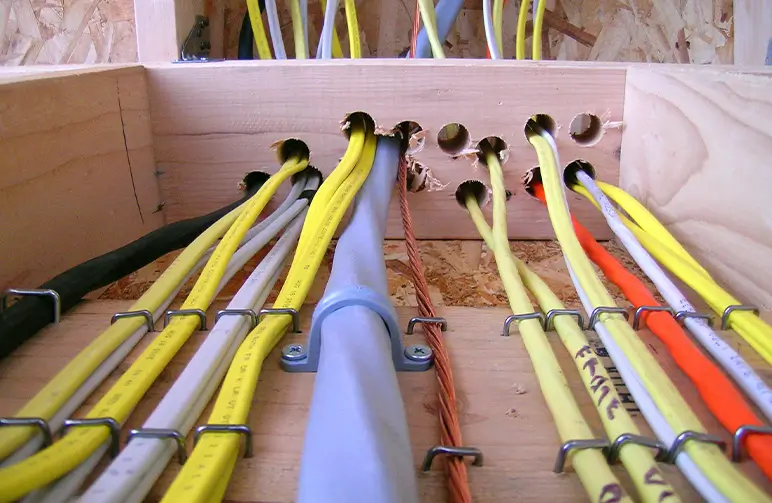
The fastest way to extend an existing circuit is to splice new cable onto the old conductors wherever they are reachable, which in a 1920s house means in the attic, in the crawlspace, or inside a wall cavity. Splices belong in a junction box, and that box has to stay accessible without tearing out drywall. A lot of 1980s work put the splice in a box and then buried the box, or skipped the box entirely and wrapped the connection in tape.
You cannot find those from the panel. You find them by opening things up, or you find them when one starts to arc.
The other version of this is on knob and tube specifically. Those conductors were designed to run separated in open air and shed heat that way. Splice modern cable to them, then let a weatherization crew blow insulation into the same cavity forty years later, and the conductor is now carrying more load than it was ever asked to carry, packed in insulation, with a connection in the middle of it.
Three-prong outlets that are not grounded
This is the one that shows up in almost every partial rewire we open.
The rewired circuits got proper grounded receptacles. The circuits nobody touched still had two-prong outlets with no ground path. At some point, somebody swapped those two-prong outlets for three-prong ones, because the plugs did not fit.
Nothing about that swap added a ground. The outlet just stopped announcing that there was no ground. Now every surge protector, every appliance with a metal case, and every plug-in tester in the house behaves as though there is a ground path when there is not. A buyer walks through, sees three-prong outlets everywhere, and has no reason to ask.
There is a legitimate way to handle an ungrounded circuit when running a new ground wire is not practical. You protect it with a GFCI and you label the receptacle to say there is no equipment ground. It is a real fix that the code allows. Almost nobody in 1984 bothered with the label, and the label is the part that tells the next owner the truth. If you want the detail on how that is done properly now, we cover it on our outlet grounding page.
A panel that looks finished
Replacing a fuse box with a breaker panel was the most common single piece of 1980s work, and it is the one that does the most damage to everyone’s judgment afterward.
The panel is the part people look at. It is the part a home inspector photographs. When it is a clean modern panel with labeled breakers, the reasonable conclusion is that the house has been updated. Sometimes the panel was the only thing updated, and behind it are the same cloth conductors that were there in 1938.
It gets worse if the panel that went in was a Federal Pacific Stab-Lok or a Zinsco, which were both being installed in this window. Both have a long documented record of breakers that fail to trip on an overload. So you can end up with a house where the modern-looking panel is itself the least reliable component, protecting old conductors that need protection more than most. That combination is not rare here. When it turns up, it usually leads to a panel replacement before anything else gets discussed.
The insurance answer nobody can give cleanly
Carriers in Washington have gotten stricter about knob and tube and aluminum branch wiring. The question on the form is close to binary: has it been removed, yes or no.
An owner of a partially rewired house genuinely does not know. They know some of it was replaced. They cannot tell you which circuits, or how much is still energized, or whether the runs in the attic are live or abandoned in place. Answering yes is a problem if a claim ever gets investigated. Answering no gets the policy declined on a house that may only need one wing done.
The house with all its original wiring at least has a clear answer.
Where this shows up in Tacoma
The pattern sorts by neighborhood, and it follows the age of the housing stock.
North of Division, in the North End, Stadium District, Proctor and Old Town, the underlying system is pre-1940. Knob and tube, cloth-insulated conductors, no ground anywhere. These are the houses where partial rewires are most common, because they are the ones people have been renovating in waves since the 1970s. Two or three separate contractors over fifty years, each touching a different part of the house, none of them documenting anything.
Hilltop has a similar age profile with a similar history of piecemeal work.
South Tacoma, the Eastside, Lincoln District, Fern Hill and parts of the West End are mostly 1950s through 1970s. The partial work here tends to be less about knob and tube and more about aluminum branch wiring from roughly 1965 to 1973, where somebody pigtailed the three outlets that were causing trouble and left the other forty terminations alone. Aluminum has to be corrected at every device or it has not really been corrected.
[Real job detail goes here. Two or three sentences on a specific partially rewired house Alex has opened up in the last year: the neighborhood, the build decade, what the previous work looked like, and what was found behind it. This is the part of the post that no competitor can copy. Do not publish without it.]
How to tell whether your house has one
None of these is proof on its own. Two or three together usually means the house was rewired in pieces.
- A modern breaker panel in a house built before 1950
- Some rooms with grounded three-prong outlets, other rooms with two-prong outlets
- Three-prong outlets that read as open ground on a plug-in tester, or that read grounded in some rooms and not others
- A kitchen or bathroom with obviously newer circuits while the bedrooms have one outlet per wall
- Cloth-wrapped conductors visible in the attic or crawlspace running alongside newer cable
- Junction boxes in the attic with no cover, or splices you can see that are not in a box at all
- A finished basement wired to a much later standard than the floor above it
- Nobody, including the previous owner, can tell you what year the work was done or who did it
That last one matters more than it sounds. Permitted work leaves a record. Work with no record was usually not permitted, which tells you something about how carefully it was done.
What we actually do about it
The first thing is finding out how much of the house is which. That means opening the panel, tracing circuits, pulling a sample of devices in the rooms that look untouched, and getting into the attic and the crawlspace. It is not a five minute look and we do not quote it over the phone.
What comes out of that is usually one of three answers.
Sometimes the old sections are small and contained, and the right job is a partial rewire done properly, on a permit, with the boundaries documented. That is a real category of work and we do it. The difference between what we do and what happened in 1984 is that the seam gets engineered instead of improvised, and there is an inspection record afterward that the next owner can rely on.
Sometimes there is too much old wiring left in too many places, and the honest answer is a whole-house rewire done in stages so you can keep living in the house. If you want to see what drives the price on those, we broke down four recent Tacoma rewire jobs and why the numbers differed.
And sometimes the branch wiring is fine and the trouble is genuinely just the panel, or a few circuits that are short on capacity. In that case you get a panel replacement or a wiring update, not a rewire. We will tell you that even though it is the smaller job. If your wiring is sound, we say so.
The permit part, which is different in Tacoma
Whatever the scope turns out to be, it needs a permit, and in Tacoma the permit does not come from the state.
Most of Washington sends electrical permits to the Department of Labor and Industries. Tacoma Power issues its own electrical permits and does its own inspections for every property it serves, which includes the City of Tacoma plus Fircrest, University Place, Fife, parts of Steilacoom and Lakewood, and unincorporated Pierce County running south. If your power bill comes from Tacoma Public Utilities, that is your permit office. You can confirm all of it on Tacoma Power’s electrical permitting page, or by calling the inspection office at (253) 502-8277.
Two things worth knowing if you are getting quotes right now. Permitting and inspection scheduling run through Accela, the city’s permitting system, rather than paper applications. And Tacoma Power moved to the 2026 National Electrical Code on June 1, 2026, so work scoped against the previous cycle can fail on details that passed last year. A contractor who normally works north of the county line will occasionally get this wrong.
We handle the application, the fees and the inspection booking as part of the job. You do not need an Accela account.
Questions we get about partial rewires
Is a partially rewired house safe to live in?
Usually yes, in the sense that most of them do not have an active fault today. The concern is that nobody knows where the old sections are, so nobody is watching them. A buried splice or an ungrounded circuit is not an emergency. It is an unknown, and unknowns in an electrical system are what turn into problems later.
Can you tell what was rewired without opening walls?
Mostly. Between the panel, the attic, the crawlspace and a sample of devices, we can map which circuits are original and which are not without cutting into finished surfaces. There are houses where the only way to be certain about one section is to open a small area, and we tell you before we do it.
My outlets are all three-prong. Doesn’t that mean the house is grounded?
No. Swapping a two-prong receptacle for a three-prong one does not add a ground wire. A plug-in tester will show open ground on those circuits. That test costs nothing and is worth doing in every room of an older house.
Do I have to redo the work from the 1980s?
Often not. If those circuits were run in modern grounded cable and they are in sound condition, they stay. What gets addressed is the old wiring they connect to and the splices between the two.
Does a partial rewire need a permit?
Yes. New circuits, replaced conductors and panel work all require one, and in Tacoma it comes from Tacoma Power. Unpermitted electrical work surfaces during a sale and gives an insurance carrier a clean reason to question a claim.
How much does this cost?
It depends entirely on how much of the house turns out to be original, and that is not knowable from a phone call. We come out, map it, and give you a written itemized number. The estimate is free, there is no trip charge, and the figure does not move unless you change the scope.
Will my insurer accept a partial rewire?
Some will, if the scope is documented and inspected and the remaining wiring is not the type they exclude. If you have a non-renewal letter or an underwriting request in hand, bring it to the estimate. We have written scopes of work to satisfy carriers before.
Get someone to look at it
If you own an older Tacoma house and you do not know what is behind the walls, that is the normal situation, not a failure on your part. Most of these houses have been worked on by people who are long gone and left no paperwork.
We map what is there, tell you which parts are sound, and give you a written number for the parts that are not. Request an estimate or call (253) 508-7529. More on what we do across the city is on our residential electricians in Tacoma page.
Alexandru Goncear Owner and CEO, ElectON Enterprise Washington electrical contractor license ELECTEL765MN
Alex is a Washington-licensed electrician working on residential systems across King, Pierce and Snohomish County. He writes every estimate himself and stays the point of contact through permitting, the work and the final inspection.
ElectON Enterprise Puyallup office, closest to Tacoma: 16709 81 Ave E, Puyallup, WA 98375 Headquarters: 36007 9th Ct SW, Federal Way, WA 98023 (253) 508-7529 Monday to Friday, 8:00 AM to 5:00 PM. Emergency service 24 hours.
Last updated August 2026.